30,000 NegOr Residents Lack Birth Registration
based on the 2024 CBMS survey
NEGROS ORIENTAL, Philippines – Nearly 30,000 residents of Negros Oriental remain unregistered in the Local Civil Registry (LCR), according to the 2024 Community-Based Monitoring System (CBMS) released by the Philippine Statistics Authority (PSA).
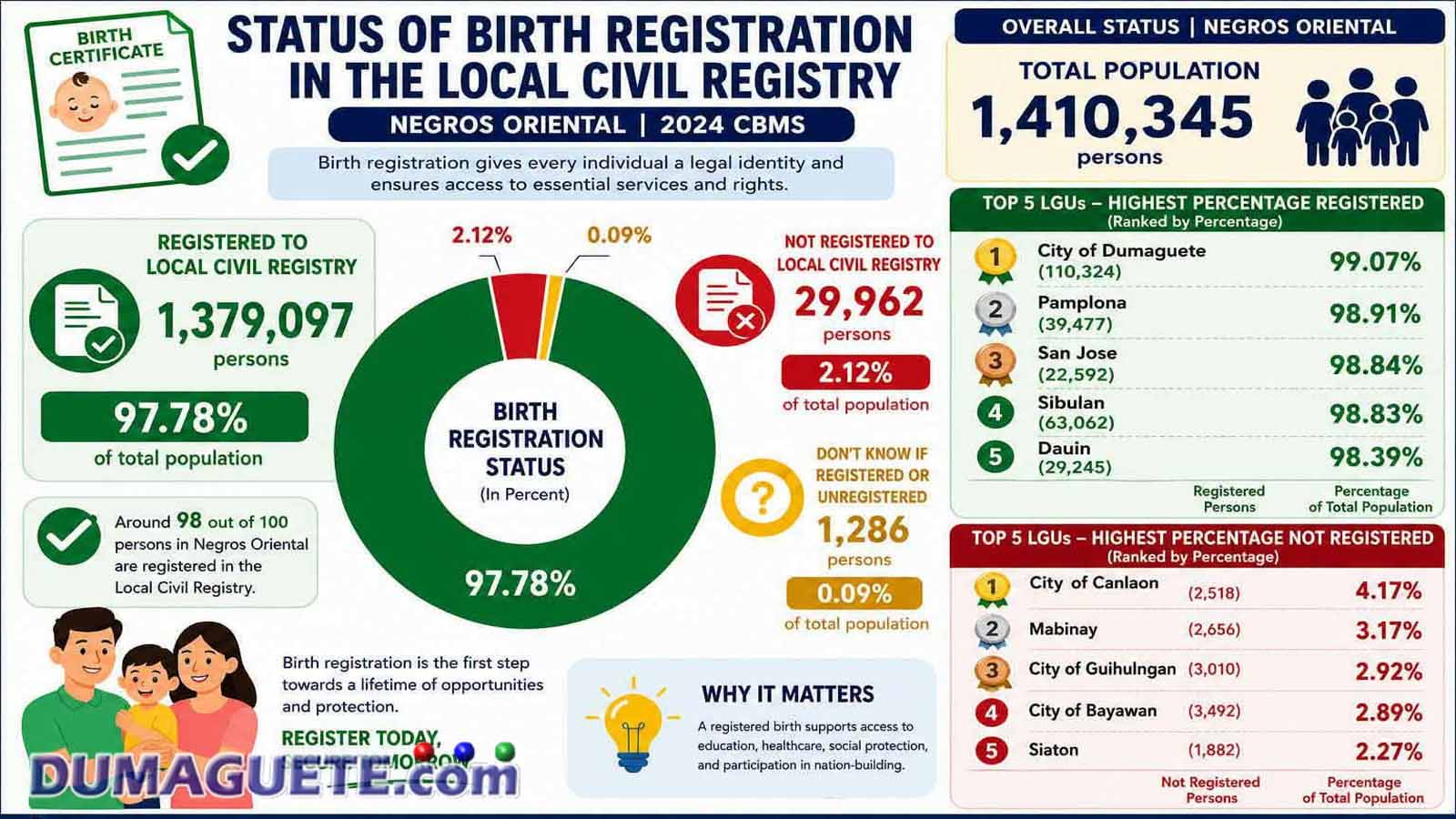
The data shows that 29,962 individuals, or 2.12% of the province’s total population of 1,410,345, have not been registered with the Local Civil Registry. Meanwhile, 1,379,097 residents (97.78%) have officially registered their births, while 1,286 people (0.09%) were unsure whether they were registered or not.
According to the PSA, birth registration is one of the most important civil registration processes, as it provides individuals with a legal identity and serves as the foundation for accessing essential government and social services.
“Birth registration is the first step towards a lifetime of opportunities and protection,” the PSA emphasized in its infographic.
Dumaguete Leads Birth Registration Rate
Among the province’s cities and municipalities, the City of Dumaguete recorded the highest percentage of registered residents at 99.07%, equivalent to 110,324 registered persons.
The other top-performing Local Government Units (LGUs) include:
- Pamplona – 98.91%
- San Jose – 98.84%
- Sibulan – 98.83%
- Dauin – 98.39%
These figures indicate that almost every resident in these municipalities has an officially registered birth certificate.
LGUs with the Highest Percentage of Unregistered Residents
While registration levels remain high across the province, several LGUs still recorded relatively higher percentages of unregistered residents.
The five LGUs with the highest percentage of unregistered persons are:
- City of Canlaon – 4.17% (2,518 persons)
- Mabinay – 3.17% (2,656 persons)
- City of Guihulngan – 2.92% (3,010 persons)
- City of Bayawan – 2.89% (3,492 persons)
- Siaton – 2.27% (1,882 persons)
Although these areas have higher percentages compared to other municipalities, the majority of their residents are still registered.
Why Birth Registration Matters
The PSA highlighted that civil registration goes far beyond obtaining a birth certificate. A registered birth allows Filipinos to:
- Establish a legal identity.
- Enroll in school.
- Access healthcare and social protection programs.
- Apply for government-issued identification documents and passports.
- Participate in government services and nation-building.
- Improve the accuracy of demographic data used for government planning and public services.
The agency encourages parents and guardians to ensure that births are registered promptly to avoid future complications in accessing education, employment, healthcare, and other public services.
According to the 2024 CBMS, around 98 out of every 100 residents in Negros Oriental have already been registered, demonstrating the province’s strong overall civil registration coverage while highlighting the need to reach the remaining unregistered population.